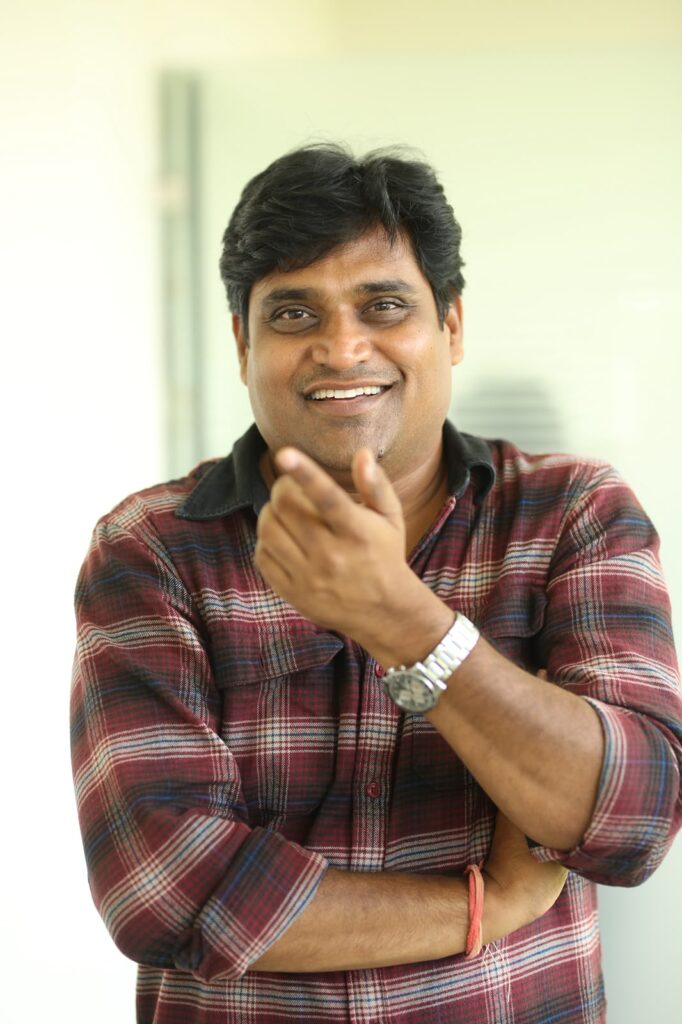
“Deewana Will Captivate Audiences of All Sections with Its Fresh Love Story” – Director Sreekanth Sangishetty
After the success of Subham, young and talented actor Harshith Reddy is returning with his new film Deewana. The film is being produced by Vasudev Koppineni and Sridevi Karyampudi under the Arha Media and V Studios banners. With this beautiful love story, actress Smeha Manimegalai and director Sreekanth Sangishetty are making their debut. Deewana is set for a grand worldwide theatrical release on June 19 through Geetha Film Distributors. Speaking at a media interaction today, director Sreekanth Sangishetty shared several highlights about the film and his journey.
Talking About His Journey into Filmmaking:
- About ten years ago, I worked as an assistant on the experimental film Minugurulu, which won a Nandi Award. The script was even archived in the Oscar Library. Later, I spent more than a decade working for a corporate company. During that period, I made small demo films, songs, and short films.
- I learned filmmaking mainly by watching movies and interviews. I never formally studied shot division, color palettes, or filmmaking techniques. I simply enjoyed watching films. If I disliked a movie, I would criticize it strongly. Whenever I saw poor writing getting opportunities, I wondered why I wasn’t getting one. That frustration stayed with me.
- I always believed my stories were special and wanted to see them on the big screen. I dreamed of people asking, “Who made this film?” after watching my work. Even while sitting at my office job for ten hours a day, my mind was occupied with cinema. I never cared about promotions because I didn’t enjoy the job. I wasn’t good at mathematics, software, or even Excel. What I was good at was dreaming.
- The dream remained alive for years. In December 2019, I came up with the idea for an investigative drama. Balancing a job and filmmaking was difficult. At one point, I even quit my job for cinema and put my wife through a lot of hardship. Later, I realized leaving a job wasn’t practical. During the COVID period, I eventually had to quit due to my father’s illness. After that, I started carrying around stories suitable for OTT platforms.
Saying about How Deewana Was Born:
- The idea for Deewana came after watching a television anchor on Gemini TV. After completing my MBA, I stopped pursuing jobs and focused on cinema. One morning, while watching television, I saw this anchor and wondered: What would happen if I went and met her? What if a complete stranger approached her? What situations could arise from that encounter? That thought became the seed for Deewana. It had both emotional depth and commercial appeal, and I felt compelled to write it.
Talking about his Writing Process:
- Whenever I had an idea, I would immediately write it down. I feared forgetting it. If I couldn’t find paper, I would even scribble it on a matchbox cover. Once the basic story was complete, I would sit at my computer and spend months developing the characters. This process usually took six to seven months. I wrote around ten drafts of Deewana. In fact, the first draft was written nearly twelve years ago. I never had the opportunity to meet big producers. Whenever I narrated the story to smaller producers, they would offer suggestions. Since they were active in the market, I treated their feedback seriously and kept improving the script. Every time I narrated the story, I made further changes and enhancements. After nearly two years, the script reached its final form.
- Stories with similar premises can be found in the works of Rabindranath Tagore and Anton Chekhov. Doordarshan’s Katha Sagar also featured many wonderful stories. However, my version is completely different. No one would imagine that my story could become a large-scale commercial film. I knew it could because the strongest commercial aspect of the film is its emotion. The emotional content is immense, and the entertainment revolves around that. The hero experiences one-sided love. In the first half, he openly pursues the heroine in an extroverted manner. In the second half, the one-sided love remains, but the pursuit takes a different emotional route.
- I spent years searching for opportunities along with my friends. Eventually, everyone moved on, and I was left alone. One day, a shoot was happening at Ramanaidu Studios, where Allu Aravind garu and Satyanand garu were present. I gathered the courage to approach them and said, “Sir, I want to narrate a story.” They were surprised. I was told that if the story was good, it would become a film; otherwise, even the tea or coffee offered during the meeting would be wasted. When I visited the office, I wasn’t even allowed inside. I didn’t know whether Aravind sir was there or not. Yet, after nearly twenty years, I finally got the opportunity to sit and have coffee with him. I narrated Deewana, and he liked it. Thankfully, that coffee wasn’t wasted.
- The film features six songs and three action sequences. I told them that whatever budget they gave me, I would make it work. I even shot a demo for just ₹5,000. Initially, I said the film required 69 shooting days, but I was asked to complete it in 30 days. My friends and I wondered how that would be possible. Eventually, we started shooting. After 42 days, there was still material left to film. Leaving out that content was challenging, but thanks to strong writing and talented actors, we were able to complete the film effectively.
Talking about Harshith Reddy’s performance:
- One producer initially suggested making the film on a budget of one crore rupees. Harshith Reddy was known to him. At that point, the project wasn’t finalized. My friend, director Uday, helped connect us. Eventually, Harshith listened to the story. It may feel like a love story from the 1990s, but I made it exactly the way I envisioned it. Deewana is a film made for everyone. Audiences who enjoy love, family emotions, and friendship will connect deeply with it.
- More than wondering whether the film has been released successfully, I constantly check whether people are reacting to it. Even if they criticize the film, I am happy because their reaction matters to me. What frustrates me are fake comments. Genuine audience responses, whether positive or negative, are what I value.
- On Talent in the Film Industry
The film industry is a fascinating place. Many music directors and writers are sometimes even more talented than directors. If we think we are talented, there are always people who are geniuses beyond us. People like Tarun Bhascker and Trivikram are examples. Music director Eswar and I used to watch films together. He taught himself music. I would narrate my stories to him regularly.
When Allu Aravind sir approved Deewana, I told Eswar about it. He appreciated the writing. Initially, when I asked him to compose music for the demo, the result was disappointing, and I scolded him. He went back, reworked it, and returned with something extraordinary. Even Aravind sir’s team loved it. People often don’t know whether something is copied or inspired, but for a low-budget demo, only a friend would stand by you. Later, when we began composing the film’s songs, Eswar delivered music that was eventually approved and appreciated.
Talking about Future Aspirations
- I have several stories that are far more ambitious than what I have made so far. Some of them are technically demanding and futuristic in nature. As a filmmaker, I need to continue making films and growing my skills. Only then will I be able to bring those stories to the screen the way they deserve.