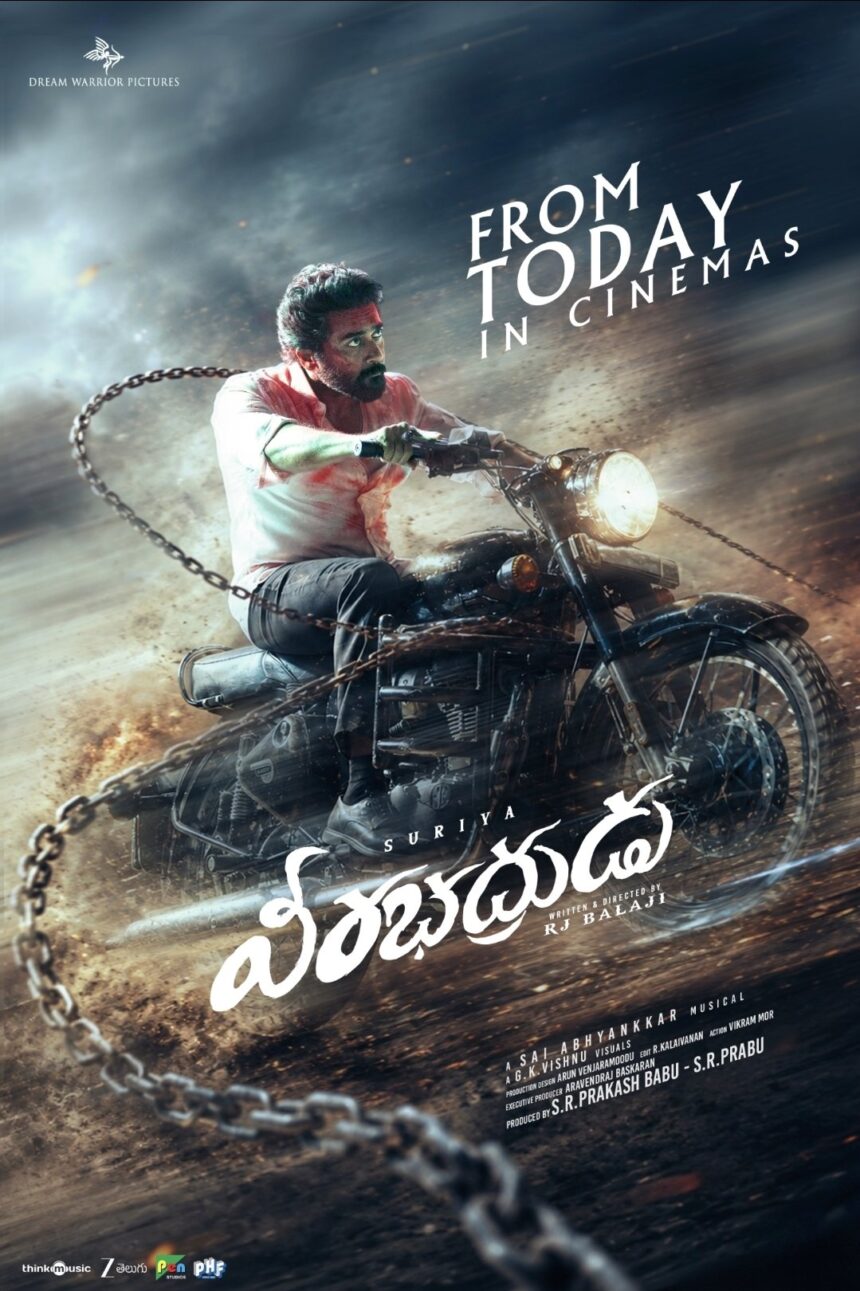
Movie Title: VEERABHADRUDU/ Karuppu
Casting: Suriya, Trisha Krishnan, RJ Balaji, Indrans, Natarajan Subramaniam , Swasika,Sshivada, Anagha Maya Ravi,Yogi Babu, Supreeth Reddy, Mansoor Ali Khan, Jaffer Sadiq, Kaali Venkat and Deepa Shank
Director: RJ Balaji
Writers: RJ Balaji, Ashwin Ravichandran, Rahul Raj, T. S. Gopi Krishnan, Karan Aravind Kumar
Producers: S. R. Prabhu & S. R. Prakash Babu
Production House: Dream Warrior Pictures
Music Director: Sai Abhyankkar
Cinematography: G. K. Vishnu
Editor: R. Kalaivanan
Release Date: May 15, 2026
Filmycycle.com Rating: ⭐⭐✨
VEERABHADRUDU: Lacks proper execution (2.5/5)
Kollywood star Suriya is back with an action entertainer titled, Karuppu. The film was directed by RJ Balaji and had a simultaneous release in Telugu as VEERABHADRUDU on May 15, 2026. Let’s Review Veerabhadrudu.
Synopsis:
A father and daughter travel from Tamil Nadu to Hyderabad, carrying a bag filled with 60 sovereigns of gold their only hope to fund the daughter’s life-saving medical treatment. But soon after arriving at Nampally railway station, tragedy strikes when the bag is stolen by a gang of thieves.
Although the police eventually recover the stolen jewels, the nightmare is far from over. Due to legal procedures, the family is forced to fight a lengthy court battle to reclaim what rightfully belongs to them.
That is when Baby Krishna, portrayed by RJ Balaji, enters the scene. A loud, manipulative lawyer with a shady reputation, he pretends to support the struggling family but instead exploits their helplessness by demanding huge amounts of money in the name of legal expenses and influence.
As the injustice around them grows, Veerabhadra Swamy, played by Suriya, arrives to challenge the corruption rooted deep within the system. However, Baby Krishna boldly questions the deity himself, arguing that true divinity lies not in miracles or supernatural strength, but in surviving as a common man and reforming society from within.
Accepting the challenge, Veerabhadra Swamy steps into the human world to confront corruption, greed, and the flaws in the judicial system. What follows is an intense battle between faith, power, and justice, as he attempts to restore hope for ordinary people trapped in a broken system, forms the crucial crux.

Performances:
Suriya appears in several shades throughout the film as a lawyer, a larger-than-life mass character, a divine figure, and even in a brief throwback-style cop avatar reminiscent of his iconic action roles. While his screen presence and charisma remain undeniable, the character itself doesn’t offer the emotional weight or powerful writing one would expect for a star of his caliber.
Trisha Krishnan plays a lawyer who is deeply drawn toward Veerabhadra Swamy and gets a fairly significant role in the narrative.
In fact, both her character and RJ Balaji’s character occupy more screen time than Suriya’s role in several portions of the film.
RJ Balaji portrays a corrupt and loud-mouthed lawyer driven by greed and influence. Though he manages to carry the role with decent energy, the writing often pushes the character into over-the-top territory, making parts of it feel less believable. Natty is suitably cast as a dishonest judge and delivers a convincing performance within the limited scope of the role.
Veteran actor Indrans leaves the strongest emotional impact as the struggling father, bringing sincerity and pain to the character. Meanwhile, Supreeth appears in a familiar rowdy role that largely follows a predictable template.
Analysis:
At its core, Veerabhadrudu attempts to blend courtroom drama with fantasy, presenting the idea of a divine force descending to Earth to punish injustice. Much like films such as Krishnarjuna and Bro, the narrative revolves around godly intervention in human affairs.
What initially appears to be an interesting concept is the limitation placed on Veerabhadra Swamy’s powers.
The film establishes that every region has its own “Kshetra Palakudu,” meaning the deity’s influence is restricted only to certain areas around Nampally and does not extend to locations like Madhapur. While this idea adds a layer of mythology, the screenplay fails to make it emotionally or logically convincing.
Director-actor RJ Balaji, who has previously explored devotional and fantasy themes successfully, struggles to maintain consistency here.
The opening portions focus on Balaji’s morally corrupt lawyer character, who manipulates loopholes in the legal system for personal gain. Alongside this runs the emotional father-daughter subplot, which gives the film some grounded moments. These early stretches are reasonably engaging and keep the narrative afloat despite a few slow scenes.
The problem begins once the film fully shifts into fantasy territory in the latter half. The storytelling becomes increasingly chaotic, with courtroom scenes resembling mass-action sequences rather than legal proceedings. Lawyers are portrayed more like faction leaders and gangsters, openly threatening people inside court premises, making the entire setup feel exaggerated and detached from reality.
One particularly over-the-top sequence involves the government immediately sanctioning a lavish new court complex in Madhapur after lawyers demand relocation from Nampally. Moments like these make the film feel more like a formula-driven commercial entertainer than a believable social fantasy.
Even Suriya, despite appearing in multiple avatars including a divine form and a brief callback to his iconic Singam-style cop image, cannot salvage the uneven second half. While his screen presence brings occasional energy, the character itself lacks the emotional depth and power expected from a star-led fantasy drama.
The climax attempts to deliver a social message about delayed justice, overloaded courts and poor judicial infrastructure, while also leaving room for a sequel. However, by that point, the narrative has already lost its grip.
Technical Department:
Sai Abhyankkar, who previously impressed with Dude, falls short of expectations here, especially in the Telugu version where none of the songs leave a lasting impression. The background score turns overwhelmingly loud at several points, reducing its overall effectiveness instead of elevating the scenes.
On the technical front, G K Vishnu delivers visually appealing cinematography with rich and polished frames throughout the film. However, RJ Balaji’s writing leans too much on familiar commercial tropes, making the narrative feel predictable. The production values, too, remain fairly average and fail to match the film’s ambitious scale.
Verdict :
Altogether, Veerabhadrudu turns out to be a film with an interesting premise but weak execution. A decent first half and a few engaging moments are overshadowed by an overdramatic and unconvincing second half, resulting in yet another disappointing outing for Suriya.